



Patient says research has transformed wellbeing
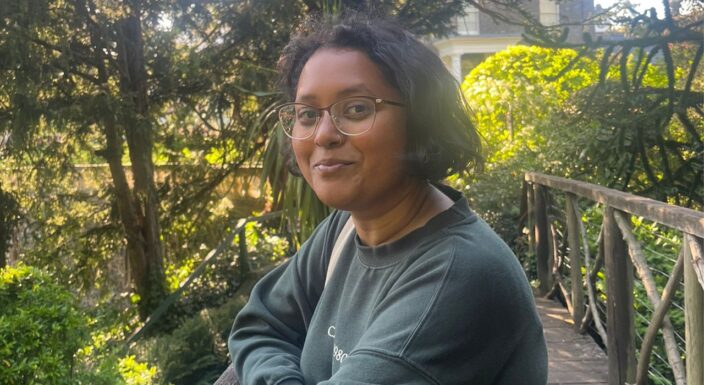
Meet Abeeda Khatun, who’s taken part in a trial here, testing whether an automated insulin delivery system can help people with type 2 diabetes.
Abeeda is sharing her story on Clinical Trials Day, today 20 May, an annual campaign to encourage the public to take part in health and care research.
The automated insulin delivery system, sometimes called an ‘artificial pancreas’, is currently only offered to people with type 1 diabetes in the UK. The COYOTE trial, led by Professor Roman Hovorka who is funded by the National Institute for Health and Care Research (NIHR), is testing if the closed-loop system can also help people with type 2 diabetes.
Abeeda, 27, grew up in East London, acting as a young carer for her non-verbal brother who has advanced learning disabilities. When she turned 14, she began to experience symptoms of type 2 diabetes:
“I remember feeling horrible all the time, really sluggish. I had an unimaginable thirst, and 99% of the time I had a headache. I don’t know how I got through it” she said.
A diagnosis of type 2 diabetes at 17 years of age gave Abeeda an answer as to why she was experiencing such symptoms. However, she struggled to cope with feeling like she was to blame for it and her mental health worsened.
Common misconceptions about type 2 diabetes include the belief that it is caused solely by eating sugar and only affects overweight people. In reality, type 2 diabetes is a complex condition caused by genetics, lifestyle, and insulin resistance.
The turning point arrived when Abeeda moved to Norwich to study graphic design at Norwich University of the Arts. She felt Norwich offered her “such a breath of fresh air” and allowed her to express herself more freely. Her move also led to the invitation to join the trial here.
For the trial, Abeeda wore a continuous glucose monitor (CGM), a device that tracks glucose levels 24/7, offering an alternative to finger-prick tests for diabetes management. A small sensor inserted under the skin measured her glucose every few minutes, sending real-time data to her smartphone.
She said: “The trial was life-changing. I used to find it awkward and difficult to do a finger prick in public spaces, especially when I felt something wasn’t right, like a hypo incoming when my blood sugar drops too low. With the CGM, when I’d go out for social events or just in everyday living, I knew I could instantly check my phone to keep track of my glucose.
“Having this level of support in my everyday life made such a difference, I felt like a different person. I’ve always kept an open mind about research. I feel like there’s always something to learn, and you could meet people who could potentially help or have some insight.”
Abeeda felt she also benefited from the support of the research team:
“The team were so lovely, the nicest people ever. The care was spot on, and they were so thorough with everything. They’d even arrange the taxis for me.”
She was also glad to help others like her:
“It felt good to be in a trial that could potentially help other people in the same spot as me. My journey could mean other people wouldn’t necessarily have to go through what I’ve had to.
“Everything about the research trial was really nice. I’m now waiting for another trial to go on!”
Professor Sankalpa Neupane, who is the NIHR Research Delivery Network Diabetes Lead in the East of England, and is Principal Investigator for the trial at NNUH, said:
“Helping patients like Abeeda has been at the very heart of the NIHR’s mission to improve people’s lives since its launch 20 years ago. We can’t make life-changing research happen without people like her taking part or our incredible research staff working in the NHS and social care, and we celebrate their impact on today’s health and care services as we mark this year’s important milestone.”
The NIHR is celebrating 20 years driving life-changing research that matters. From faster diagnoses to better treatments and improved quality of care, NIHR research changes lives across the UK. For research to happen faster and work for everyone, sign up to Be Part of Research.
- If you would like to find out more about health and care research visit bepartofresearch.uk.