




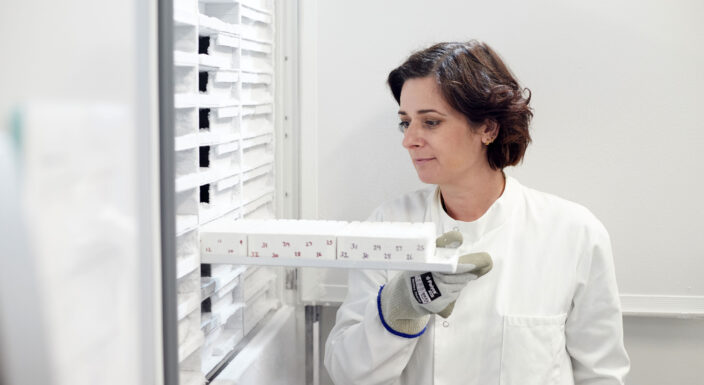
Landmark for new tonsil biorepository
One of the first UK tonsil biorepositories has been established to help improve scientific understanding and treatment for a range of oral health conditions.
Scientists and clinicians at Quadram Institute Bioscience (QIB) and our hospital have joined forces to set up the oral biorepository, which will store tissue following tonsillectomy procedures.
The first tissues were stored earlier this month after a child had their tonsils removed at the Jenny Lind Children’s Hospital to treat reoccurring tonsilitis.
The biobank has been established following a grant from the Quadram Institute Clinical Seedcorn Fund to help clinicians develop research ideas with scientists at the Quadram Institute, which is funded by QIB and the N&N Hospitals Charity.
The hospital carries out around 700 tonsillectomies a year and tonsilitis is one of the most common reasons for children to be admitted to hospital.
Prof John Phillips, Consultant Ear, Nose and Throat (ENT) Surgeon at NNUH, said the biorepository landmark was the first step to opening up the potential for new research studies into a range of oral conditions.
“This is a great collaboration and follows seedcorn funding last year to set up a biobank for tonsils and a knowledge exchange. Usually, when we remove the tonsils of a child, the tissue goes into medical waste. This is the first step to demonstrate we can store the tissue – in the future there is the possibility to extract DNA to further our understanding of a number of conditions that affect children and adults. There are so many opportunities with this – I am most interested in the causes of tonsilitis and the bacteria that causes it and my consultant colleague Alfred Addison is exploring cancer genetics in adults and treatment outcomes for patients with oral cancers.”
Permission has already been granted to store 32 samples through the Norwich Research Park Biorepository, which will be securely stored and anonymised following patient consent. The team are hoping to collect around 300 samples following Health Research Authority (HRA) approval which will include tonsils, saliva, cheek and tongue brushings.
Dr Jennifer Ahn-Jarvis, Food and Health Human Studies Lead at QIB, said: “We are very pleased to be working on this project – we are not aware of many biobanks that collect tonsils and could lead to new research opportunities to help improve patient care in the future. The project highlights the unique benefits of having a university hospital so close to our scientists at the Quadram to get samples from theatres to the lab within minutes. The unique position of the NRP Biorepository (between NNUH and QIB) is an excellent example why our model works and has so much potential for growth.”
Later this year, the Quadram Institute will be hosting an international oral tissue symposium.
The Quadram Institute is a partnership between Quadram Institute Bioscience, NNUH, University of East Anglia and the Biotechnology and Biological Sciences Research Council (BBSRC). Its mission is to deliver healthier lives through innovation in gut health, microbiology and food and its vision is to understand how food and microbes interact to promote health and prevent disease.
The tonsil biobank is one of seven research projects to receive a share of £250,000 in seedcorn funding grants from the N&N Hospitals Charity with the charity continuing to support research projects.
N&N Hospitals Charity Director Rachel Backshall said: “Research is the key to unlocking better treatments, earlier diagnoses and improved care for future generations. Everyone who makes a donation or supports our charity enables us to invest in pioneering projects that could make a real difference to patients’ lives.
“We simply couldn’t support research like this without the people who choose to donate to our charity. Their support is helping to drive innovation, expand medical knowledge and create a healthier future for people in Norfolk and beyond.”
To find out for more about supporting N&N Hospitals Charity, email charity@nnuh.nhs.uk