


Acute Frailty Intervention Service launched
The Acute Frailty Hub offers rapid, early care to help older patients return home safely.
In 2023-24, over 65s made up roughly 20% of ED attendances in England, just over 40% of admissions and occupied around 66% of hospital beds.
Frailty is a distinctive health state related to ageing in which the body loses its inbuilt reserves, affecting an individual’s ability to recover from a period of ill health. Appropriate management, particularly in the first 24 hours, is crucial for people living with frailty.
In alignment with the NHS Long Term Plan and to meet increasing demand, we’ve launched the Acute Frailty Hub to provide rapid assessment and early intervention for patients living with frailty, enabling same-day discharge and increasing the number of people returning safely to their homes.
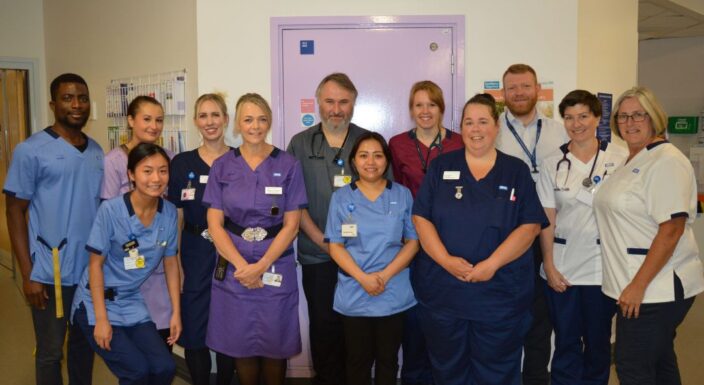
Sharon Wrath, Lead Nurse for Frailty, said: “Previously we had an area called the Older People’s Emergency Department (OPED) and Older People’s Ambulatory Care (OPAC), a three-bedded bay that’s been relocated to the former Discharge Lounge, and the two services are now known as Frailty SDEC.
“Operating across two dedicated areas under the umbrella of the Frailty Hub is Frailty SDEC and the Frailty Unit, formerly known as Loddon Ward. The Frailty Unit is a 72-hour short-stay ward supported by a dedicated multi-disciplinary team (MDT) with access to front door services to support early discharge.
“All patients over the age of 65 are screened using the Clinical Frailty Scale (CFS). Patients with a frailty score of six and above are identified as being at most need of a Comprehensive Geriatric Assessment (CGA). A CGA is recognised as the gold standard for assessing older people living with frailty, involving an MDT approach to provide treatment and follow-up care to meet individual needs.
“There is also a dedicated “Silver Line”, a direct communication channel to our consultant geriatrician. This line, with access via the Unscheduled Care Co-ordination Hub (UCCH), supports community-based clinicians, community matrons and GPs to discuss the best pathway and treatment for people living with frailty. Through timely discussion, we can often prevent unnecessary hospital admissions, facilitate same-day diagnostics and treatment or referrals into the Out-patients Assessment Service (OPAS).
“The introduction of frailty here is a pivotal shift in how we approach care, focusing on early intervention, prevention and person-centred planning. It supports the reduction of risks associated with hospitalisation in our frail, older adults and our goal to reduce length of stay.
“When frailty is properly understood and managed it can make a tangible difference to patients’ lives, helping them maintain dignity, independence and better outcomes.”