


The clinical trial, “SIGHT: Spatial Inattention Grasping Therapy”, is in collaboration with UEA, Norwich Research Park and Therapeutic Services research leadership.
A stroke can affect the brain’s ability to interpret information which, in some cases, can make the stroke survivor lose attention to things on one side of their body.
This means that their brain does not process information received from the impaired side, resulting in a disabling cognitive condition called “spatial inattention” or “spatial neglect”.
There are 1.3 million stroke survivors in the UK, with an estimated 390,000 of those suffering from spatial inattention.
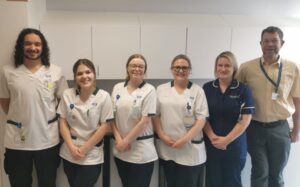 The Principal Investigator is Dr Kneale Metcalfe, Consultant Stroke Physician, with Kelly Price, Clinical Specialist Occupational Therapist (Stroke), acting as Co-Principal Investigator.
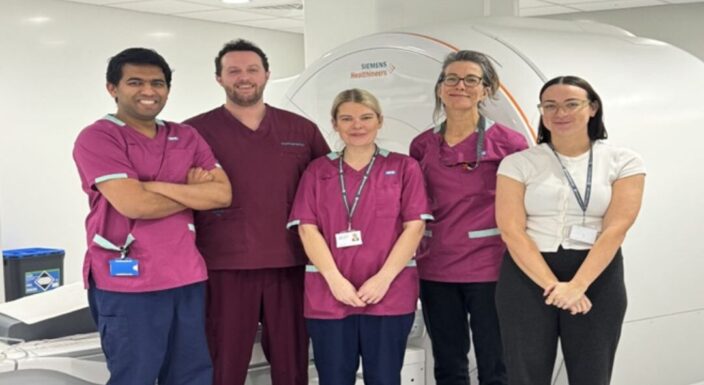
They are supported by a collaboration of our Neurosciences Occupational Therapy, MRI Research Imaging and Stroke Research Delivery teams.
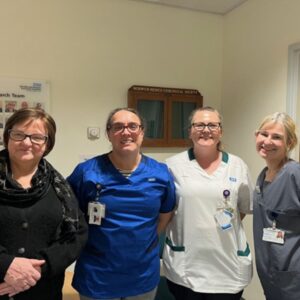 Kneale said: “The complexity of this trial requires MRI scanning, complex interventional treatments from the Specialist Occupational Therapy Stroke and Stroke Research team to conduct the trial procedures.
“Healthcare staff follow national stroke guidelines but currently there is no effective treatment for spatial inattention. The UEA has worked with stroke survivors, carers and healthcare staff to create a therapy for spatial inattention called SIGHT (Spatial Inattention Grasping Therapy).
“SIGHT is trialling a new rehabilitation therapy that’s provided alongside the usual care that patients who have had a stroke would receive.
“206 stroke survivors with spatial inattention will be allocated to two groups – one group will receive SIGHT and the usual care, the other will only receive the usual care.
“To compare the effect of the therapy we will assess patients’ ability to attend to objects and carry out daily life tasks before the therapy starts, immediately after therapy, and three months after therapy.
“If the study shows that it reduces the effect of spatial inattention it could transform therapy worldwide.”
UEA Trial Chief Investigator Dr Stephanie Rossit, Associate Professor, School of Psychology, said: “This condition can be highly persistent, with 40% of stroke survivors continuing to experience symptoms a year post-stroke. The SIGHT trial is helping to fill the gap in the urgent search for successful treatments.
“We are delighted that the MRC-NIHR has funded this £1.26 million study, which is the largest study of a spatial inattention therapy to take place anywhere in the world.
“Our colleagues at NNUH have been working incredibly hard on this study and we have been able to deliver the study at an extremely high standard so far.”
Rebekah Girling, Clinical Services Research Lead, said” This trial is a great triumph for NNUH staff, Norwich Research Park and the UEA for stroke rehabilitation in the region, demonstrating innovation and utilisation of our expert staff and facilities across Imaging and Therapeutic Services.”