


East Diagnostics Imaging Network funds mobile imaging car
A pilot has been launched to explore the benefits of delivering hospital-based imaging services at home. The aim is to improve accessibility, reducing hospital admissions and enhancing outcomes for frail and elderly patients.
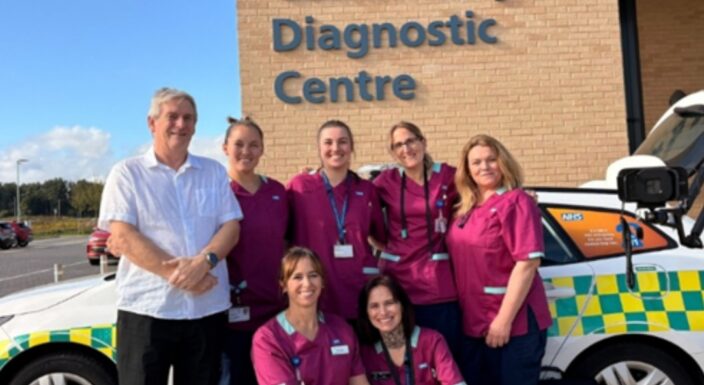
The scheme, funded by the East Diagnostics Imaging Network (EDIN), uses a low-powered Fujifilm mobile imaging device so that X-rays can be taken in the community and uploaded without the need of a specially-adapted room. The equipment can be used to rule out fractures in the upper and lower limb extremities which would normally result in a visit to A&E.
The initiative has been led by the Transformation team and delivered by a team of community radiographers from NNUH, with extensive technical and governance support from a range of NNUH partners and the Norfolk and Waveney Integrated Care Board, with referrals and clinical oversight provided by Integrated Care 24.
“It was clear from the start that protecting elderly and frail patients from a lengthy A&E wait benefits everyone involved,” said Tom Davies, Transformation Programme Officer. “By taking the service into the home, we’ve got happier patients and fewer ambulances being tasked which has helped reduce pressures at the front door of A&E.”
As with any new service, real world conditions have inevitably thrown up difficulties, not least trying to mitigate for the unpredictability of every visit.
“Rural connectivity, adaptable safety procedures, room limitations and patient handling are a small example of the flexibility needed by the whole team,” said Tom. “Success has been driven by the proactive approach from everyone involved in seeing this initiative work”.
Three months in and that success is already becoming apparent, with data collected so far showing 72% of patients seen by the mobile imaging service have avoided an unnecessary trip to A&E. Feedback from patients has also been extremely positive, with 96% of people preferring the option of a home visit and 100% satisfaction with the care they’ve received.
Tom added: “Being able to keep patients in their own homes is really beneficial in reducing the stress and anxiety which comes from being in an unfamiliar hospital environment.”
Emma Key-Yeomans, General Radiography and Reporting Radiographer Service Lead, said: “One of the first patients to be seen was a 101-year-old lady. A visit from the imaging team immediately removed the stress and uncertainty of spending Friday evening in the A&E department. We were able to rule out a fracture and provide wrap around care in under two hours, all from the comfort of her own home.”
With the current imaging car pilot is due to run until March next year, the team are already reviewing plans to expand the service, encompassing more referral pathways and a broader patient eligibility criterion in preparation for a busy winter period.